





The Death of the Change Log: Why "Silent" Security Updates Are the New Normal in 2026
For decades, the hosting industry operated under a predictable security rhythm. A major local privilege escalation (LPE) kernel vulnerability would emerge perhaps once a year. System administrators would scan the vendor change logs, assess the threat, and schedule a patch window or server reboot when convenient.
That era is officially over.
In a matter of just a few weeks, the industry has suffered a rapid succession of root exploits — Copy fail, Dirty frag, and Fragnesia, to name a few. We are no longer dealing with isolated, seasonal security events. We are living through a continuous barrage where new critical kernel vulnerabilities are surfacing weekly. Based on what I'm seeing, the next three to six months will be extremely intense, and the overall elevated threat environment will persist for roughly a year and a half.
The Death of the Change Log: Why "Silent" Security Updates Are the New Normal in 2026
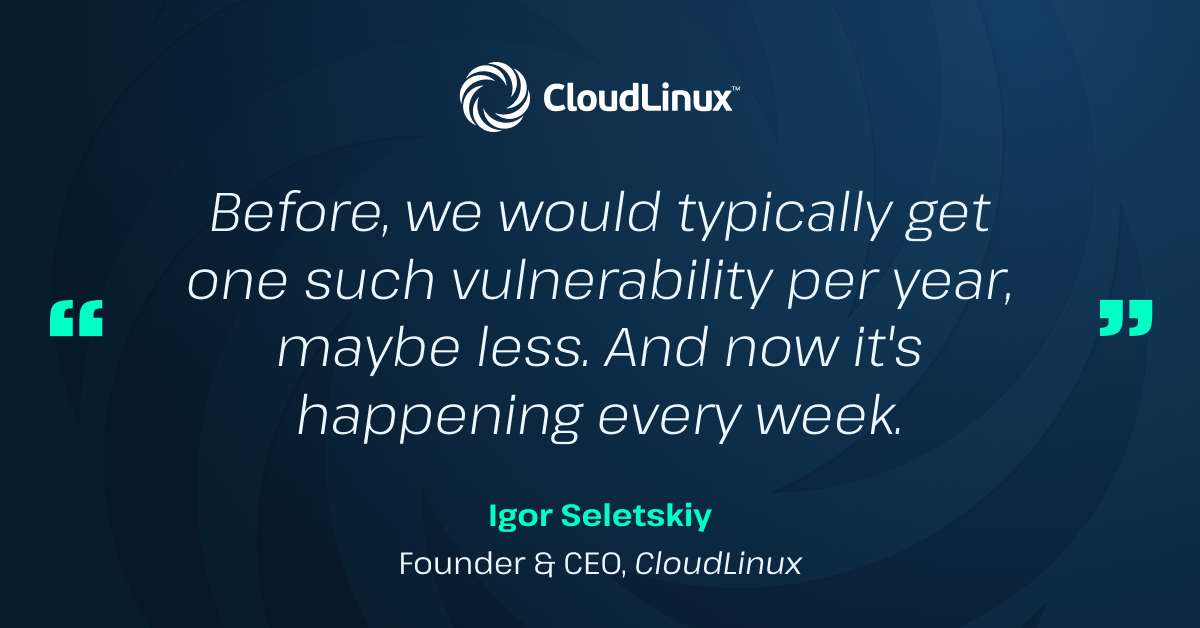
For decades, the hosting industry operated under a predictable security rhythm. A major local privilege escalation (LPE) kernel vulnerability would emerge perhaps once a year. System administrators would scan the vendor change logs, assess the threat, and schedule a patch window or server reboot when convenient.
That era is officially over.
In a matter of just a few weeks, the industry has suffered a rapid succession of root exploits — Copy fail, Dirty frag, and Fragnesia, to name a few. We are no longer dealing with isolated, seasonal security events. We are living through a continuous barrage where new critical kernel vulnerabilities are surfacing weekly. Based on what I'm seeing, the next three to six months will be extremely intense, and the overall elevated threat environment will persist for roughly a year and a half.
CIFSwitch (CVE-2026-46243): Mitigation and Kernel Update on CloudLinux
Researcher Asim Manizada disclosed CIFSwitch, a Linux kernel local privilege escalation in the CIFS / SMB client's SPNEGO upcall path. The bug has been latent in the kernel since 2007 and the public proof-of-concept (manizada/CIFSwitch) shipped together with the oss-security disclosure on 2026-05-28. On affected hosts, any unprivileged local user can use it to gain root in a single command. The vulnerability is tracked as CVE-2026-46243.
CIFSwitch (CVE-2026-46243): Mitigation and Kernel Update on CloudLinux
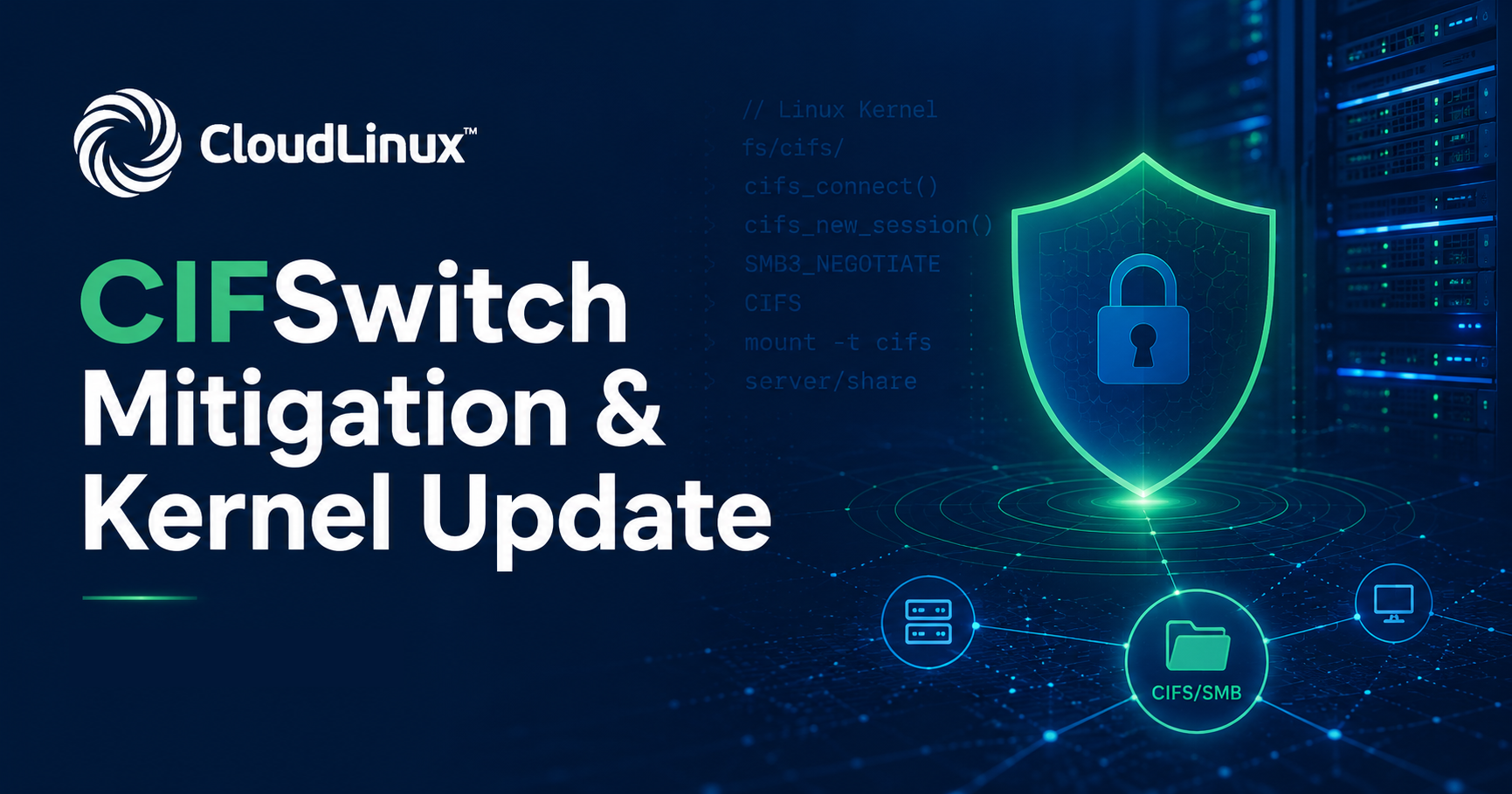
Researcher Asim Manizada disclosed CIFSwitch, a Linux kernel local privilege escalation in the CIFS / SMB client's SPNEGO upcall path. The bug has been latent in the kernel since 2007 and the public proof-of-concept (manizada/CIFSwitch) shipped together with the oss-security disclosure on 2026-05-28. On affected hosts, any unprivileged local user can use it to gain root in a single command. The vulnerability is tracked as CVE-2026-46243.
Introducing CloudLinux 9.8 Stable Release
CloudLinux 9.8 is now generally available. It tracks AlmaLinux OS 9.8 (“Olive Jaguar”) with the upstream 5.14 kernel, refreshed compiler toolchains, and new Python 3.14, MariaDB 11.8, and PostgreSQL 18 versions. The CloudLinux LVE stack, mod_lsapi, and PHP/Python/Node.js Selector packages have been rebuilt against the new kernel.
Introducing CloudLinux 9.8 Stable Release
CloudLinux 9.8 is now generally available. It tracks AlmaLinux OS 9.8 (“Olive Jaguar”) with the upstream 5.14 kernel, refreshed compiler toolchains, and new Python 3.14, MariaDB 11.8, and PostgreSQL 18 versions. The CloudLinux LVE stack, mod_lsapi, and PHP/Python/Node.js Selector packages have been rebuilt against the new kernel.
Introducing CloudLinux 10.2 Stable Release
CloudLinux 10.2 is now generally available. It tracks AlmaLinux OS 10.2 (“Lavender Lion”) with the upstream 6.12 kernel, refreshed compiler toolchains, and new Python 3.14, MariaDB 11.8, and PostgreSQL 18 versions. The CloudLinux LVE stack, mod_lsapi, and PHP/Python/Node.js Selector packages have been rebuilt against the new kernel.
Introducing CloudLinux 10.2 Stable Release
CloudLinux 10.2 is now generally available. It tracks AlmaLinux OS 10.2 (“Lavender Lion”) with the upstream 6.12 kernel, refreshed compiler toolchains, and new Python 3.14, MariaDB 11.8, and PostgreSQL 18 versions. The CloudLinux LVE stack, mod_lsapi, and PHP/Python/Node.js Selector packages have been rebuilt against the new kernel.
Inside Our New AI Support Assistant: A 55% CSAT Lift and Customer Feedback to Match

A purpose-built virtual assistant — trained on our own knowledge base — is changing how customers get answers.
Inside Our New AI Support Assistant: A 55% CSAT Lift and Customer Feedback to Match
A purpose-built virtual assistant — trained on our own knowledge base — is changing how customers get answers.
Three root exploits in two weeks: What's your patching strategy?
On April 29, 2026, a Linux kernel privilege escalation called Copy Fail (CVE-2026-31431) became public on the oss-security mailing list. A short Python script, runnable by any unprivileged user, returned a root shell on most enterprise Linux servers running kernels from 2017 onward.
Three root exploits in two weeks: What's your patching strategy?
On April 29, 2026, a Linux kernel privilege escalation called Copy Fail (CVE-2026-31431) became public on the oss-security mailing list. A short Python script, runnable by any unprivileged user, returned a root shell on most enterprise Linux servers running kernels from 2017 onward.
PinTheft (CVE-2026-43494) kernel LPE: CloudLinux platforms are not affected
Researcher Aaron Esau and the V12 Security team disclosed PinTheft, a Linux kernel local privilege escalation that chains an RDS zerocopy reference-count bug with io_uring fixed buffers to overwrite the page cache of a SUID-root binary. A public proof-of-concept is available. Any unprivileged local user on an affected host can use it to gain root.

PinTheft (CVE-2026-43494) kernel LPE: CloudLinux platforms are not affected
Researcher Aaron Esau and the V12 Security team disclosed PinTheft, a Linux kernel local privilege escalation that chains an RDS zerocopy reference-count bug with io_uring fixed buffers to overwrite the page cache of a SUID-root binary. A public proof-of-concept is available. Any unprivileged local user on an affected host can use it to gain root.
How Hosting Providers Are Fixing Their VPS Profitability Problem in 2026

VPS is the biggest growth opportunity in hosting right now. According to the 2026 Web Hosting Trends Report, 65% of providers reported revenue growth last year and 26% rank VPS as their top growth category. The demand is there. The customers are signing up.

How Hosting Providers Are Fixing Their VPS Profitability Problem in 2026
VPS is the biggest growth opportunity in hosting right now. According to the 2026 Web Hosting Trends Report, 65% of providers reported revenue growth last year and 26% rank VPS as their top growth category. The demand is there. The customers are signing up.
Linux Kernel ptrace Exit-race Vulnerability / ssh-keysign-pwn (CVE-2026-46333) — Mitigation and Kernel Update on CloudLinux
Right after the kernel privilege-escalation chain in the XFRM/ESP subsystem (Copy Fail, Dirty Frag, Fragnesia), Qualys disclosed a different Linux kernel issue. This time in the ptrace access-check path. CVE-2026-46333 is reserved for tracking this vulnerability. A public proof-of-concept exists. An unprivileged local user on an affected host can use it to read root-owned secrets (SSH host private keys and the shadow password database) without obtaining root privileges directly.

Linux Kernel ptrace Exit-race Vulnerability / ssh-keysign-pwn (CVE-2026-46333) — Mitigation and Kernel Update on CloudLinux
Right after the kernel privilege-escalation chain in the XFRM/ESP subsystem (Copy Fail, Dirty Frag, Fragnesia), Qualys disclosed a different Linux kernel issue. This time in the ptrace access-check path. CVE-2026-46333 is reserved for tracking this vulnerability. A public proof-of-concept exists. An unprivileged local user on an affected host can use it to read root-owned secrets (SSH host private keys and the shadow password database) without obtaining root privileges directly.
Fragnesia (CVE-2026-46300) — Mitigation and Kernel Update on CloudLinux
Less than a week after Dirty Frag, researcher William Bowling and the V12 team disclosed a third Linux kernel local privilege escalation in the same broad area (XFRM / ESP) and named it Fragnesia. A working public proof-of-concept exists. Any unprivileged local user can use it to gain root in a single command.
Fragnesia (CVE-2026-46300) — Mitigation and Kernel Update on CloudLinux
Less than a week after Dirty Frag, researcher William Bowling and the V12 team disclosed a third Linux kernel local privilege escalation in the same broad area (XFRM / ESP) and named it Fragnesia. A working public proof-of-concept exists. Any unprivileged local user can use it to gain root in a single command.